Darent and Cray Catchments
On this page;
- News
- Catchment Improvement Groups
- Water Framework Directive
- My Environment
- Useful Links
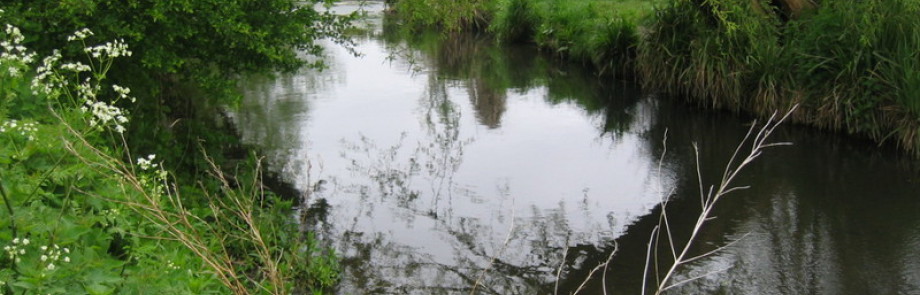
The Darent and Cray are groundwater fed chalk rivers located in north-west Kent and south-east London. Chalk rivers are characterised by clear water, abundant aquatic plants, low banks and comparatively stable flows, but the Darent and Cray like most rivers within the UK they are not as healthy as they should be.
The Darent has suffered from over-abstraction in the past and has on a number of occasions virtually dried up on many sections. Both the Darent and Cray have been heavily modified to provide power for milling and current problems include pollution, non-native invasive species and physical modifications.
As a result two Catcment Improvement Groups have been set-up, one for the Cray and more recently one for the Darent. These groups consist of organisations who represent the different interests on the rivers and who are working to identify the actions for improvements.
News
Darent, book is launched!
Darent by Rod Shelton forms a compendium of information about this area of North West Kent, compiled for the first time into a single volume. It embraces the
formation of the land and its river; who and what lived here in prehistoric times; the mills which once abounded along this river and, above all, the histories and stories of every village and market
towns – from Westerham up to the Dartford Marshes. Lavishly illustrated with hundreds of photos, drawings and reproductions, the book makes for easy reading as well as an ideal reference work.
To find out more or to purchase a copy visit;
Advice for riverside ownership

Living on the Edge PDF.pdf
Adobe Acrobat document [484.3 KB]
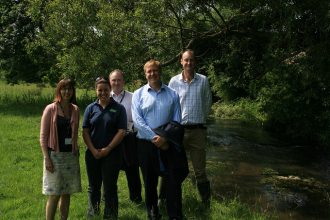 L-R Angela Gorman Environment Agency, Louise Smith NWKCP, Chris Hazelton Environment Agency, Ed Mitchell Director of Environment and Business Environment Agency, Keith Wallington Darent Valley Trout Fishers
Environment Agency consultation launched in Kent
A national Environment Agency initiative seeking input from everyone who benefits from our water environment has been officially launched by the banks of River Darent in Kent.
Ed Mitchell, Director of Environment and Business for the Environment Agency, visited Kent to launch the Challenges and Choices consultation. A project which sees the Environment Agency seeking people’s views on the issues affecting the water environment and what should be done to continue to improve it.
Input and advice is being sought from all aspects of the community; from businesses and utility companies to wildlife organisations and members of the public, and everyone in between.
The Environment Agency knows that local communities know their water environment better than anyone else, so if there is a particular issue affecting the health of your local river, you have ideas on how to solve the problems, or you have a good news story we can learn from then we want to hear from you. Perhaps you’ve seen firsthand the transformation of a river or lake in your community and want to let us know how this was achieved? Positive or negative, your experiences and views could help shape the future of our water environment.
By working with our partners and local communities, we have already had some notable successes. Hard work is underway across Kent and the South East to improve water quality and habitats in a number of rivers.
This is why the Challenges and Choices consultation was launched by the banks of the River Darent near Shoreham, it is a location that has already benefited from a number of recent projects. A group of local fisherman have carried out significant habitat improvement work just north of Shoreham; members of the River Darent catchment improvement group, chaired by the North-West Kent Countryside Partnership, have delivered habitat improvements in the area; and the Environment Agency recently signed an agreement with Thames Water to reduce the amount of water abstracted from the river, which previously had dried out during extended dry periods.
You can give your views via the Environment Agency’s online consultation (www.environment-agency.gov.uk/challengesandchoices) or send them to us by email, fax or letter. All the views will be published anonymously on our website and will be fed into a revised River Basin Management Plan – a document which sets out our plans for improving the water environment across the South East from 2015 to 2021.
Howard Davidson, South East Regional Director for the Environment Agency, said: “The quality of our water environment has improved significantly over the past 20 years but there is still much more to do and we can’t do it alone.
“Local communities will know the issues affecting their rivers and streams better than anyone, and we want them to get involved and have their say. The best way to continue to protect and improve the water environment is by everyone being actively involved, which is why we want communities and our partners to share their views with us. We will use those views to shape the way we work in the coming years to protect our water environment for our future generations.”
The Environment Agency will produce a summary report by the end of January 2014, and a response report by the end of March 2014 that will summarise the views and comments received during the consultation and what will happen next.
Study links insecticides use to invertebrate die-offs
The world's most widely used insecticide is devastating dragonflies, snails and other water-based species, a groundbreaking Dutch study has revealed.
On Monday, the insecticide and two others were banned for two years from use on some crops across the European Union, due to the risk posed to bees and other pollinators, on which many food crops rely.
However, much tougher action in the form of a total worldwide ban is needed, according to the scientist who led the new study.
"We are risking far too much to combat a few insect pests that might threaten agriculture," said Dr Jeroen van der Sluijs at Utrecht University. "This substance should be phased out internationally as soon as possible." The pollution was so bad in some places that the ditch water in fields could have been used as an effective pesticide, he said.
Van der Sluijs added that half the 20,000 tonnes of the imidacloprid produced each year is not affected by the EU ban. It is used not to treat crops, but to combat fleas and other pests in cattle, dogs and cats. "All this imidacloprid ends up in surface water," he said.
The research, published in the peer-reviewed journal PLOS One, found that 70% less invertebrate species were found in water polluted with the insecticide compared to clean water. There were also far fewer individuals of each species in the polluted water. "This is the first study to show this happens in the field," van der Sluijs said. As well as killing mayflies, midges and molluscs, the pollution could have a knock-on effect on birds such as swallows that rely on flying insects for food, he added.
To read more visit;
http://www.guardian.co.uk/environment/2013/may/01/study-links-insecticide-invertebrate-die-off
'Love Your River' campaign
Double Olympic gold medal-winning rower James Cracknell and Natural Environment Minister Richard Benyon today urged the public to show their support for the ‘Love Your River’ campaign.
The ‘Love Your River’ campaign encourages people to value their local river and shows the relationship between water in a river and the water used in the home.
Natural Environment Minister Richard Benyon said:
“I am delighted that James Cracknell has come on board as the ‘Love Your River’ Campaign Adviser. James has a great passion for rivers and is the perfect person to explain the many benefits that rivers bring to our everyday lives. We rely on rivers for much of the water we use, so it is in all our interest that we protect and cherish them."
To find out more about this campaign visit;
Catchment Improvement Groups (CIG)
The Darent and Cray Catchment has an Environment Agency Catchment Co-ordinator and a Catchment host, North West Kent Countryside Partnership (NWKCP). We are committed to working together to
encourage greater local participation at the catchment level and achieve more for people and the water environment.
To do this we will undertake catchment planning which aims to explore environmental issues, challenges and opportunities within the river catchment at a local level through stakeholder engagement.
Through partnership working, actions for innovative and collaborative solutions can be explored and delivered. This approach will connect existing activities and foster greater local ownership for
greater action and engagement.
The CIGs are helping to prioritise work and deliver actions by facilitating a joined-up approach that will deliver actions in an efficient way across organisations. CIGs work flexibly and in ways
that will help deliver the most for a catchment.
In order to do this WE NEED YOUR HELP!
The CIGs will be hosting events, workshops and consultations to understand your prioirties for the river, you can also contact the chair of each group to discuss representing your group/organisation at the CIG or to find other ways to become involved.
Catchment Improvement Group contact details:
Darent Catchment Improvement Group
Chair: Louise Smith, North West Kent Countryside Partnership
Email: l.smith@nwkcp.org
Cray Catchment Improvement Group
Chair: Mark Gallant, North West Kent Countryside Partnership
Email: m.gallant@nwkcp.org
Environment Agency Catchment Coordinator
Angela Gorman
Email: angela.gorman@environment-agency.gov.uk
More Information about each Catchment Improvement Group can be found on the following pages:
- Cray CIG
The Water Framework Directive
The Water Framework Directive is a Europe wide scheme initiated in 2003 aiming to improve the ecological status of the entire water environment. Read more about it here.
To deliver this across Kent, the Environment Agency catchment co-ordinators and partners will work together on identifying catchment improvement priorities, developing projects and identifying funding sources.
 Darent and Cray Catchment Map
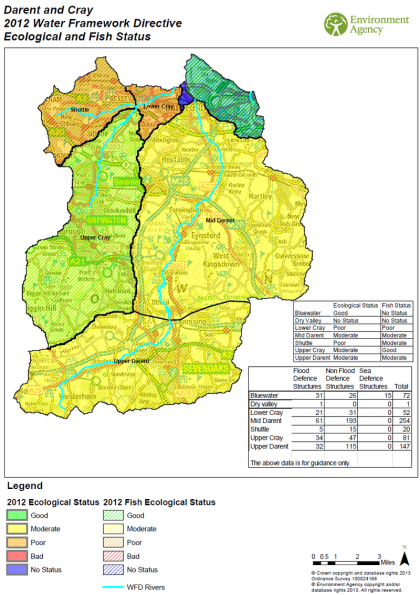 Water Framework Directive Status Map
My Environment
The website My Environment aims to connect people with nature through better access to on-line environmental information.
By bringing a wide range of sources of information about the natural environment together in one place, My Environment enables you to see how the UK is responding to environmental challenges, find out about the environment in your local community, learn how you can play your part in creating a better environment, and find out how you can benefit from connecting with nature.
To visit the website My Environment click here.
Useful Links
Environment Agency - Catchment Based Approach
www.environment-agency.gov.uk/catchments
DEFRA
http://www.defra.gov.uk/environment/quality/water/legislation/water-framework-directive/
Cascade consulting – Catchment Change Management Hub
http://ccmhub.net/
Water Framework Directive
http://www.environment-agency.gov.uk/research/planning/33362.aspx
World Wildlife Fund - Our work on the Water Framework Directive
http://www.wwf.org.uk/what_we_do/safeguarding_the_natural_world/rivers_and_lakes/where_we_work/rivers_in_the_uk/our_work_on_the_water_framework_directive.cfm
Your Tidal Thames – Pilot Catchment Based Approach
Visit the website to view the working Catchment Plan
http://www.thames21.org.uk/project/your-tidal-thames/
Wild Trout Trust
Angling Trust
River Restoration Centre

Get involved!
Find out how by contacting us at:
North West Kent Countryside Partnership
Hall Place
Bourne Road
Bexley DA5 1PQ
Tel: 01322 621 239
E-mail:
nwkcp01@kent.gov.uk
or
sara.spellman@kent.gov.uk
Explore Kent
For further volunteering opportunities, please click on the link below:
 Print
Print 